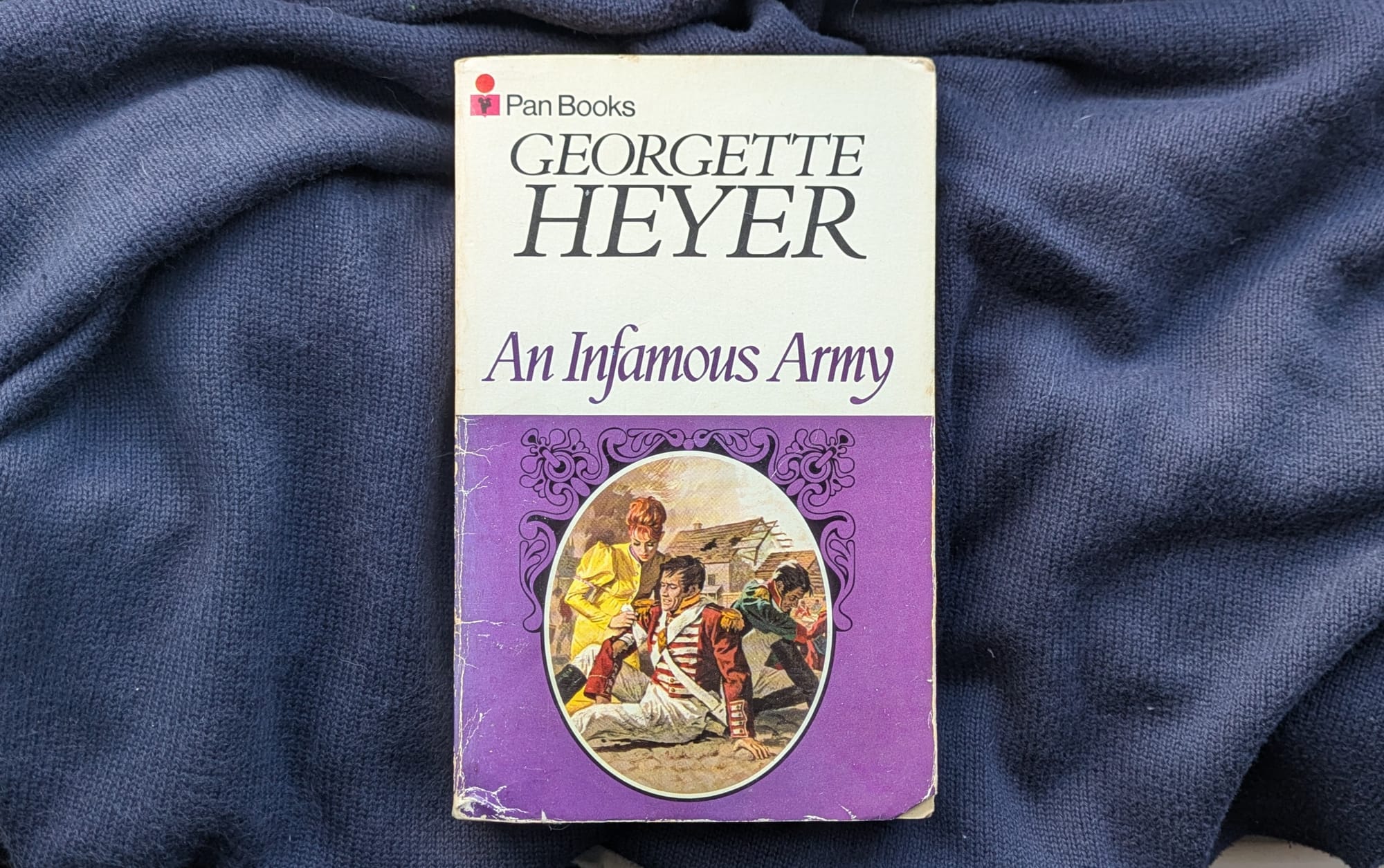
This is the 1961 Pan paperback edition of An Infamous Army. The novel was originally published by Heinemann in 1937.
I've had a marvellous time over the past couple of months reading the Alastair-Audley tetralogy: These Old Shades, Devil's Cub, Regency Buck and now An Infamous Army. It's taken me from 1926, when Georgette Heyer was a just-married young author in her early twenties, to 1937, when she was a mother in her mid thirties who had published over a dozen novels. I've read about the 1750s, the 1780s and the 1810s. Wigs and patches have come and gone, although it continues to be a bad idea to wear puce.
I was aware of An Infamous Army by reputation long before I embarked on this project of reading all of Heyer's historical fiction. It's her Waterloo novel, famously providing such an accurate description of the battle that it was recommended to military trainees at Sandhurst. I had heard this factoid so often that I thought it might be a flattering myth, but Heyer biographer Jennifer Kloester was able to confirm the truth of it, learning from a former instructor that army personnel and military historians alike value it as a teaching aid. This would no doubt have delighted Heyer, who in order to write this novel spent many months reading sources, including all of the Duke of Wellington's correspondence, and filled her house with maps of the battlefield.
The book covers most of the "Hundred Days" that elapsed between Napoleon's escape from exile on Elba and his meeting with the Coalition force — Wellington's "infamous army" of the title — in what was then the Netherlands on Sunday 18th June 1815. Just over half of the novel is focused on the social scene in Brussels in the later winter and spring of 1815, as Wellington was assembling troops and commanders in the area. The rest is devoted to a detailed play-by-play of the battle itself, much of it focusing on the activities of Colonel Audley, an aide-de-camp to the Duke.
Audley was a minor character in Regency Buck, the younger brother of the Earl of Worth who marries his ward, Judith, at the end of that book. At the start of An Infamous Army, set three years later, the Worths are taking advantage of the freedom to travel again in Europe, after the Bourbon restoration of 1814. They — along with many other leading members of British society — are in Brussels, holding balls, going on picnics and attending military parades. Also engaged in these pursuits is Lady Barbara Childe, the red-headed granddaughter of Dominic and Mary from Devil's Cub, who are now the Duke and Duchess of Avon. The chronology absolutely doesn't work for them to have got married in the early 1780s and already have a fully-grown and once-widowed granddaughter in 1815, but I don't think Heyer cared about that and nor do I, really.
Audley and Bab, as she is known, are quickly embroiled in a love triangle with "Brussels' most notorious rake", the Comte de Lavisse. Bab has been carrying on with Lavisse for some months, as well as engaging in other scandalous behaviour such as going for morning rides by herself, taking laudanum drops and appearing at a ball with painted toenails. She's also blunt in her speech and uninterested in affecting maidenly virtues she doesn't possess — as a young widow, she has more license than the average debutante. She's probably the closest thing a woman can be to a rake in 1815, in the sense that she truly does not care what anyone else thinks of her social activities or romantic entanglements. She even describes herself this way during a marriage proposal.
Early on, she is introduced to Audley, who is handsome and good at riding and also noble and honourable and reliable enough to excel in an important job in the army. Something in her — probably the part that doesn't enjoy having to take laudanum to be able to sleep at night — realises that she could be truly happy with him. They quickly confess their love and become engaged, only for Bab to rebel against marital expectations while Audley is constantly sent away from Brussels on army business. Theirs is an on-and-off, fight-and-make-up kind of engagement that echoes the unsettled nature of life in the spring of 1815. Everybody knows that a confrontation with Napoleon is coming. Nobody knows exactly when or where it will be. The balls and parties continue, full of handsome young officers who won't live to see the summer. It's a brittle, troubled time.
Then comes the action of the battle, to which Heyer devotes ten whole chapters. Audley's role as aide-de-camp to Wellington allows the reader to see up close how the Duke directs the strategy. Audley also acts as one of Wellington's messengers, taking orders to other commanders in the field, so that we also get to hear different perspectives from across the battlefield. In a nice bit of plotting, when Audley is injured on such an errand, it is Bab's erstwhile lover Lavisse who helps him and completes his mission by delivering the message.
Meanwhile, Bab and Judith are back in Brussels, doing what they can for the columns of wounded men who are being ferried back to the city. I found this section incredibly moving, as Heyer describes the inadequate preparations for medical care (they're still erecting a field hospital in one of the parks 24 hours after the fighting has begun) and how the city's few doctors are overwhelmed by the number of patients. Bab acquits herself well, nursing dying men in the street for hours on end, and we (and Judith) get a glimpse of the decent person who has been hiding under flippancy and flirting all this time. At the conclusion, Bab's drama with Audley is resolved in a satisfactory way that feels true to both of their characters.
I greatly admired An Infamous Army. It's a truly impressive feat of research and description. Some of the sections that deal with the human cost of war, such as those about the plight of the wounded, are excellent. But I didn't enjoy reading it, for the most part. I have never been very interested in the kind of history that dwells in the details of who stood where on a battlefield, nor in the Napoleonic Wars. This book overflows with both of these things: many pages are given over to descriptions of where various regiments are and what all their different uniforms look like, and the jostling for power that is going on between the different powers allied against Napoleon.
I found the first half of the novel, pre-battle, rather slow, and then the battle section itself too stuffed with descriptions of artillery bombardments and troop manoeuvres. The level of precision and detail in the battle section that makes this book a great military teaching aid renders it slow going for a reader like me (that's why this post has taken me two weeks rather than my usual one!). In her author's note, Heyer pre-empts the comparison to Thackeray's Vanity Fair, acknowledging the debt and saying that she hadn't read that novel for years when she wrote An Infamous Army. I likewise haven't read that book in a long time, but from what I remember I think I would have preferred it if Heyer, too, had made Waterloo one episode in a longer, more character-focused, story.
That said, I did enjoy Bab and Audley's love story, although I wished that there was more of it. I also had very little interest in the romantic B-plot, a forbidden marriage between two minor characters. That was all dealt with so sparingly that it felt like Heyer couldn't summon much attention for it either. I liked the glimpses provided of real-life historical figures, such as Lady Caroline Lamb in her outrageously transparent gown and the Duchess of Richmond, who really did hold a grand ball on the eve of the battle. Heyer's deft way of including such characters was much improved from Regency Buck. The cameos at the end of An Infamous Army from the Duke and Duchess of Avon were delightful, given how much I enjoyed their characters in Devil's Cub. I also gained a much better understanding of the scope of Wellington's achievements as a general: he was a politician as much as a tactician and did a superb job of keeping all the European commanders pointing in the right direction instead of fighting over who was going to pay for what. Did I want to know so much about that, though? Not really. My note on one long section about British-Prussian military liaison techniques just reads: "I simply do not care."
To me, this book felt like more of a study aid than an entertaining novel. Well-written as it is, I wouldn't rank it among my favourite Heyers so far. And it will be a long time before I want to read anything else about the relative attractiveness of Hussar uniforms versus Guards uniforms.
Five Other Thoughts
Judith's focus in the early sections on finding a good husband for Miss Devenish felt rather like Emma Wodehouse's championing of Harriet Smith.
Puce-watch continues: at a ball a plain young woman in a gown of "particularly harsh puce" stands next to Miss Devenish and makes her look angelic in white by comparison.
One of my favourite descriptive passages was the one about Bab and Audley galloping down the Allée in Brussels in the early morning light. Beautiful writing.
We get a small dose of casual anti-semitism in the description of La Catalani, an opera singer Wellington hires as the entertainment for his ball. She is "sharp as a Jew" and haggles fiercely over her fee.
I did miss the versions of Judith and Peregrine from Regency Buck, who raced curricles and attended cock-fights. They were both rather staid and middle-aged in this book, even though it is set only three years later so they will both be in their twenties. The generational maths of this novel is all out of kilter.
My Favourite Phrases
A gossipy man settles down for "a comfortable prose" — ie, a chat? — with his hostess.
There is "nothing more effulgent than his hessians with their swinging tassels" — I suspect Heyer went diving into the thesaurus to find the right adjective for Audley's very shiny boots.
"Such a quiz of a hat!".
"Oh, toll-loll!" as a sceptical exclamation.
Napoleon is described as "a Corsican ogre".
Thanks for reading. I'm making making way through Georgette Heyer's historical novels — you can find all the entries so far here.
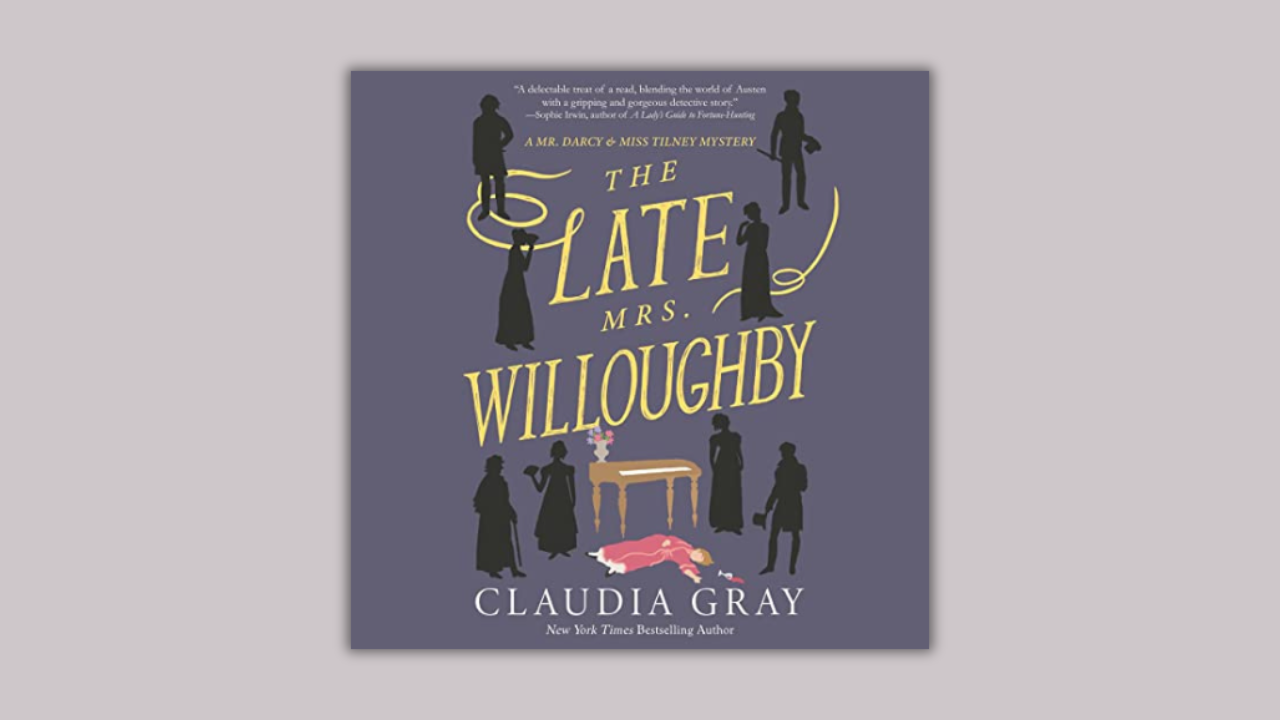
After several months of good progress, I've experienced a bit of a health setback in the past couple of weeks and found it difficult to focus on physical books. (I've written a little more about my experiences of long-term illness here). I asked my podcast production assistant Leandra, who I know is an avid audiobook listener, if she could recommend me any cosy, easy-to-consume titles that would fit my general tastes. And, kind soul that she is, she immediately provided a dozen options that fall somewhere in the realm of historical/mystery/fantasy/science fiction. I got searching on my library apps and this, the second book in the Mr Darcy and Miss Tilney series, was the first one available.
I read the first book in this series — The Murder of Mr Wickham — as an ebook last year. I've read a lot of Austen follow-ons and fanfiction (it's a bit of a project of mine) and I enjoyed the way Claudia Gray blended together the timelines of the different Austen novels so that characters like Emma Wodehouse, Elizabeth Bennet and Anne Eliot could interact in the same book. The addition of an original plot in the form of a well-paced mystery elevated this book above the others of this type that I've read; Gray took the story onwards into new territory, rather than rehashing events that Austen had already covered.
Where The Murder of Mr Wickham puts the details from Emma and Pride and Prejudice at the fore, The Late Mrs Willoughby takes us into the realm of Sense and Sensibility. Both of our sleuth characters from the first book — Jonathan Darcy, son of Fitzwilliam and Elizabeth, and Juliet Tilney, daughter of Catherine from Northanger Abbey) — find themselves in Barton, Devonshire, where Austen's novel is mostly set. Jonathan is there as a reluctant houseguest of his school bully, Mr Willoughby, who has recently married and inherited his rich aunt's estate. Juliet, meanwhile, is making an extended visit to Marianne Brandon (née Dashwood), after striking up a friendship in the previous book in this series.
At a neighbourhood party, Mrs Willoughby dies horribly after drinking port laced with arsenic. It's awfully convenient for her husband, who disliked her and married her for her money, and terribly sad for another of his guests, whom she had spurned in favour of Willoughby's proposal. Marianne is also suspected and rumours of poison as a "woman's weapon" make life very unpleasant for her. Mr Darcy and Miss Tilney step in once more to investigate, skirting the bounds of propriety to question servants, perform chemical analyses of the poison, and interrogate their hosts. I will admit that I correctly guessed the identity of the culprit about halfway through, but this didn't impair my enjoyment of the whole story.
As well as working the case, our two protagonists make some emotional breakthroughs in their friendship, which is handled in a believable and period-appropriate fashion. The careful portrayal of Jonathan Darcy as neurodivergent centuries before such a term existed is done well, too. I found him to be a better-realised character in this book, where he existed separately to his parents, who will always be harder for a modern author to write convincingly because they carry the baggage of their Austen versions and all of the adaptations thereof.
I found Billie Fulford-Brown's reading of the book very easy and pleasant to listen to (and as an erstwhile audio editor, I am a notoriously picky audiobook consumer). The pace and momentum she kept up had me listening in every available moment and very nicely distracted from my symptoms. I plan to continue the series in audio and am waiting impatiently to borrow the next book, The Perils of Lady Catherine de Bourgh.
If you purchase this book from one of the following places, I receive a small commission that supports my writing. The price remains the same for you.
The "looking back on myself in 2016" trend of recent weeks has convinced me that the confessional online personal essay is back (if it ever really went away). Here's a great example of the form.
Someone in the thick of the AI-obsessed tech sector writes: I miss thinking hard.
This site where you draw a little horse and watch it frolic along with other people's little horses is oddly mesmerising and enjoyable (via reader Robin).
Speaking of cinema: Mark Kermode's review of Melaniais a great piece of criticism. A sample phrase: "It's a heist movie about a crime family breaking into the seat of power and stealing the cutlery whilst destroying democracy."
I am a passionate fan of the Dutch track athlete Femke Bol. It's nice to know that Geoff Dyer is too. He explains what's so magnetic about her better than I could (via my husband Guy).
Miss where you used to live (in the UK)? This site lets you generate accurate-sounding rail announcements for specific routes and stations.
"Here’s the truth: you’re not stuck because you’ve lost your ambition; you’re stuck because the dilapidated model for ambition you’ve been working with since childhood is broken beyond repair. I’m sorry. I’m doubly sorry because my industry, book publishing, did a lot of work to foist this shoddy model onto you in the first place. For a long time, my colleagues in nonfiction and I elevated mastery as a moral good, rewarding the people who swore they could explain the whole world in a single argument. These people promised us optimised futures full of clarity and control, and we platformed that nonsense."
This is one of those weird article-length X/Twitter posts, and I'm sorry about that, but it makes an interesting point about how the tide is finally turning on optimisation-hustle culture.
I'm always fascinated to learn how much it really costs to do nice things on the internet. Here, the creator of openbenches.org (which is a free, crowd-sourced map of memorial benches all around the world) explains how it stays online.
I loved this piece about "New York City Ghosts", a phrase the writer has coined to explain the feeling when the city itself trying to scare you off: "When New York is actively ejecting you like a transplant that won’t take."
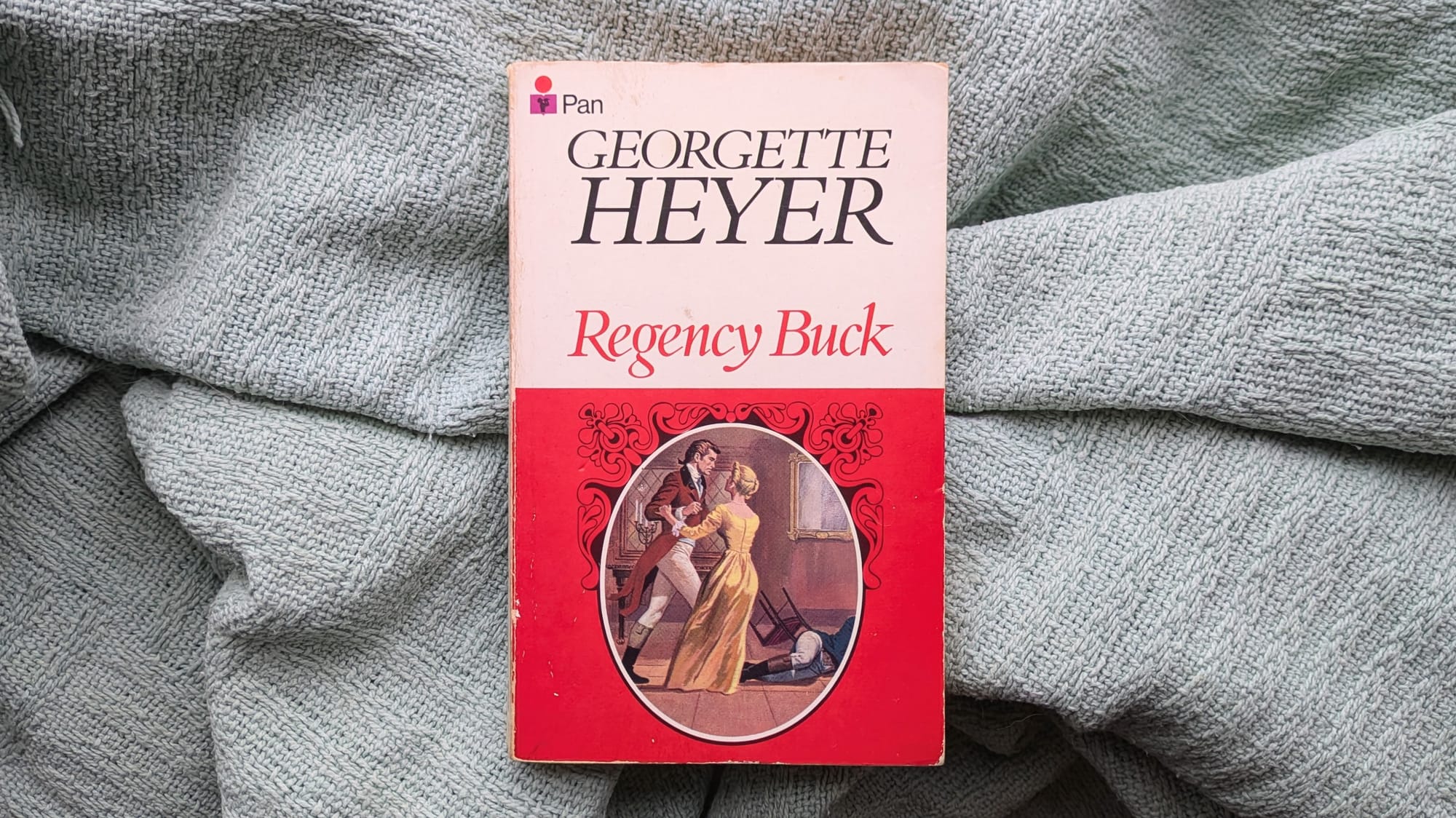
I really wanted to like Regency Buck. Although I've enjoyed all of my Georgette Heyer reading so far, I was particularly excited to arrive at one with "Regency" in the title. She's most famous for fiction set in this period and now, after my introductory sojourn in the 1750s and the 1780s, I thought I had arrived at the main event. And this is, most certainly, a novel set during the Regency. In fact, the historical details of that period came at me so thick and fast that it was easy to forget that there was also a story somewhere underneath.
The problem is, I think, that Heyer was also very excited to have arrived at the Regency. It's a fascinating period of history, to be sure: there was much change and upheaval socioeconomically and politically, as well as in fashion, culture and architecture. I understand the impulse to research it thoroughly — and according to Jennifer Kloester's biography of Heyer, she did exactly this, borrowing lots of books from the London Library. The novel that she produced from all of this reading is very heavy on non-fiction elements, to the detriment of its quality as fiction.
Untangled from all the historical detail, Heyer's plot has promise. It centres around a wealthy but still underage brother and a sister — Judith and Peregrine Taverner — who have decided to abandon their boring life in Yorkshire for the social whirl of London society. Once there, they spar with their reluctant yet overbearing guardian, the Earl of Worth, while enjoying the riding, the clothes and the parties that match their new lives as young rich people on the town. Perry has various escapades, including a duel, while Judith revels in her status as a desirable heiress.
Partway through, everyone relocates to the seaside and we get one of the best sequences of the book, in which Judith and Perry race their curricles from London to Brighton. This section is both truly exciting and just revealing enough of the historical details involved in such an enterprise. The same goes for the account of Perry's duel, which is a rare point of suspense in the book, and for Judith's uncomfortable encounter with the Prince Regent at the Pavilion. That was the one moment where I felt she became a real character rather than a mere cipher, as she suddenly realised that she had allowed herself to be manoeuvred into a private room, alone, with a powerful and predatory older man. These glimpses of a better balance between plot and research give me hope for the Regency novels I've yet to read.
Once in Brighton, family jealousies come to a head, there are not one but two abductions, and eventually Judith decides that her guardian is much better suited to being her husband. In her appraisal of this book, Mari Ness compares the plot unfavourably with that of Pride and Prejudice and with hindsight I can see the similarities, but while I was reading the book I noticed none of that romantic misunderstanding or tension. Since the Earl of Worth gets little dialogue that isn't about paying his wards' debts or forbidding their wilder hobbies, his "romance" with Judith doesn't feel earned or even real. It compares unfavourably to the way the growing harmony between Dominic and Mary is gradually revealed in Devil's Cub.
So much for my disappointment in Regency Buck as a work of fiction. I did, however, find it to be a fairly readable non-fiction introduction to Regency society. Many of Heyer's characters are real historical figures, with special prominence accorded to Beau Brummell, the Duke of Clarence and the Prince Regent. There are lots of period set pieces that are described in evocative detail, such as a boxing match at a country inn, a London cock fight, an evening at Almack's, and a soiree at the Pavilion in Brighton. The sections that deal with how Brummell curated trends and started fashions are interesting, as is the deep dive into the appeal of snuff.
But oh, the name-dropping is endless! This is a celebrity tour of the Regency era disguised as a novel. There are just so many needless cameos from real historical figures that do nothing to advance the plot, such as an appearance by Lord Byron and one from Matthew Lewis, author of The Monk. Jane Austen also gets a little mention, although she isn't personally present. And while I did enjoy the Wikipedia rabbit hole I went down to learn more about "the Clarke scandal", it similarly had no real relevance to this novel.
Heyer's deep knowledge of her period settings is one of the main things readers enjoy about her historical fiction. In the other novels I've read so far, she deploys a deft touch in blending history with fiction, such as in the brief appearance of Louis XV and Madame de Pompadour during the Versailles scenes in These Old Shades. In Regency Buck, though, it feels as though she was just so keen to disseminate facts about the Regency that she allowed her research to crowd out all the other wonderful things she could do.
Other Thoughts
I loved the description of the Earl of Worth's bed. It's enormous, supported by bronze gryphons and topped by a red silk canopy. So opulent.
There are more masculine-only spaces in this book that I've experienced in Heyer so far, such as the crowd for the boxing match and cock fight, the boxing gym that Worth and Peregrine frequent, and the parlour at Cribb's pub.
This novel takes an unexpected turn into being quite Christmassy for a bit — there is a festive section spent in the snow at Worth's country estate.
Poisoned snuff is such a funny means of murder. I wonder why Heyer didn't try it in her detective fiction.
Slang Corner
Early on, Peregrine goes to an inn's dining room to eat a "tight little beefsteak".
A "turnip watch" is the most elegant kind of timepiece a man can carry.
At Vauxhall, a fashionable party has "ham shavings and burnt wine in a box".
"Daffy", meaning gin.
"Cream pot love", to describe a mercenary marriage proposal to an heiress from a royal duke.
Peregrine mentions how Worth has bought up his "vowels", meaning his IOUs from gambling.
Thanks for reading. I'm making my way through Georgette Heyer's historical novels — you can find all the entries so far here.
I thought I would end up reading less. When I abolished my annual reading target — in response to the fact that in 2025 I read 121 books but felt frustrated about it — I did so in the expectation that I would not read as many books. Without the promise of that accomplished glow every time I marked a book "read" on the Storygraph, moving one digit closer to my goal, I assumed that I would end up taking things more slowly. I liked that idea: being more deliberate and considered, rather than reading at a breathless pace because there's a finishing line to reach. I predicted that I might finish three, perhaps four books this month.
It didn't turn out that way. I read nine books in January. I only averaged ten a month last year, when I thought I was reading too much too quickly (in ebook form especially). But I didn't feel like I was rushing from one to the other, perhaps in part because a couple of these were titles that I had started at some point last year and then put down, either because something more urgent came up (the perils of having a podcast about books) or because the book seemed too long/slow to keep me on pace for my end-of-year goal. I felt at liberty to pick them back up again now, which I think shows the lack of expectation is having the intended effect so far.
So what did I read? Keep going for details of:
three classic crime novels
two loosely-connected works of historical fiction
a contemporary Regency romance
a collection of literary fiction short stories
a fantasy adventure audiobook
and a non-fiction coffee table book about sheep
I was able to take a slightly slower start to the year with my detective fiction podcast, Shedunnit, because I recorded January's episodes before breaking for Christmas. The three crime novels I read this month, therefore, were all looking ahead to future projects (as opposed to the frantic overnight book-cramming I'm sometimes doing before recording dates).
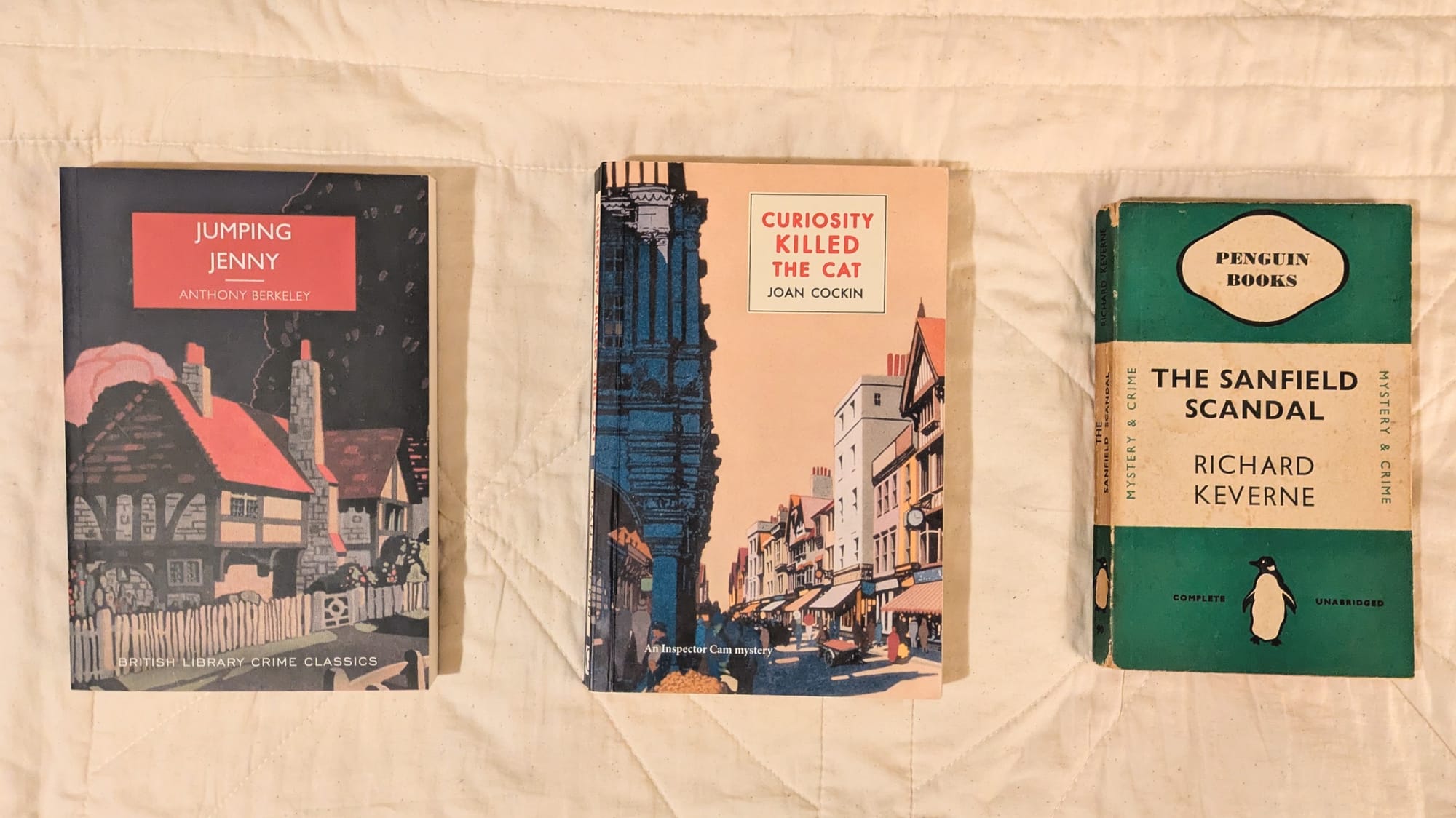
Jumping Jenny by Anthony Berkeley from 1933 is an unpleasant but deeply fascinating novel that I'll be talking more about in a history-focused episode towards the end of February. It focuses on Berkeley's regular amateur sleuth, crime writer Roger Sheringham, at a country house fancy dress party where a woman ends up hanged on a gibbet that was meant to be part of the decorations. Up to this point, the setup could have been conceived by any 1930s crime writer. Only Berkeley would have thought to make Sheringham a deliberate accessory after the fact, in the sense that he tries to "clean up" the scene to protect a friend, and then spends the rest of the novel trying to evade the police's efforts to get at the truth. It's a really compelling formal experiment that merges the "howdunnit" with the "whodunnit" and, although not exactly comfortable reading, I would recommend it if you're interested in crime fiction innovation.
Curiosity Killed the Cat by Joan Cockin is the Shedunnit Book Club's chosen book for February, and podcast members will shortly be able to hear my thoughts about it at length in a special bonus episode (it comes out on 11th February, I believe). This is a post-WW2 novel, set in a Cotswolds village that was overtaken by an evacuated government department during the war which then didn't leave in 1945. It's now 1949 and the tension between locals and incomers is riding high. I found the setting and period details of this book more interesting than the plot, which wasn't especially exciting.
The Sanfield Scandal by Richard Keverne was a book that I knew nothing at all about before I started reading — which doesn't happen very often for me anymore. This is the value of the Green Penguin Book Club series that I do on Shedunnit: it makes me read books that I would never otherwise have encountered. They were famous enough to be included by Penguin ninety-odd years ago, but their fame has not lasted. I enjoyed reading this gentle, Famous Five-esque thriller (even though Blyton had not started that series when this book was published in 1929). I liked it in large part because its central castle reminded me of a) Orford Castle, where I spent many happy hours as a child on family sailing holidays b) the abbey in the Abbey series. The full episode about this book will be coming out in March.
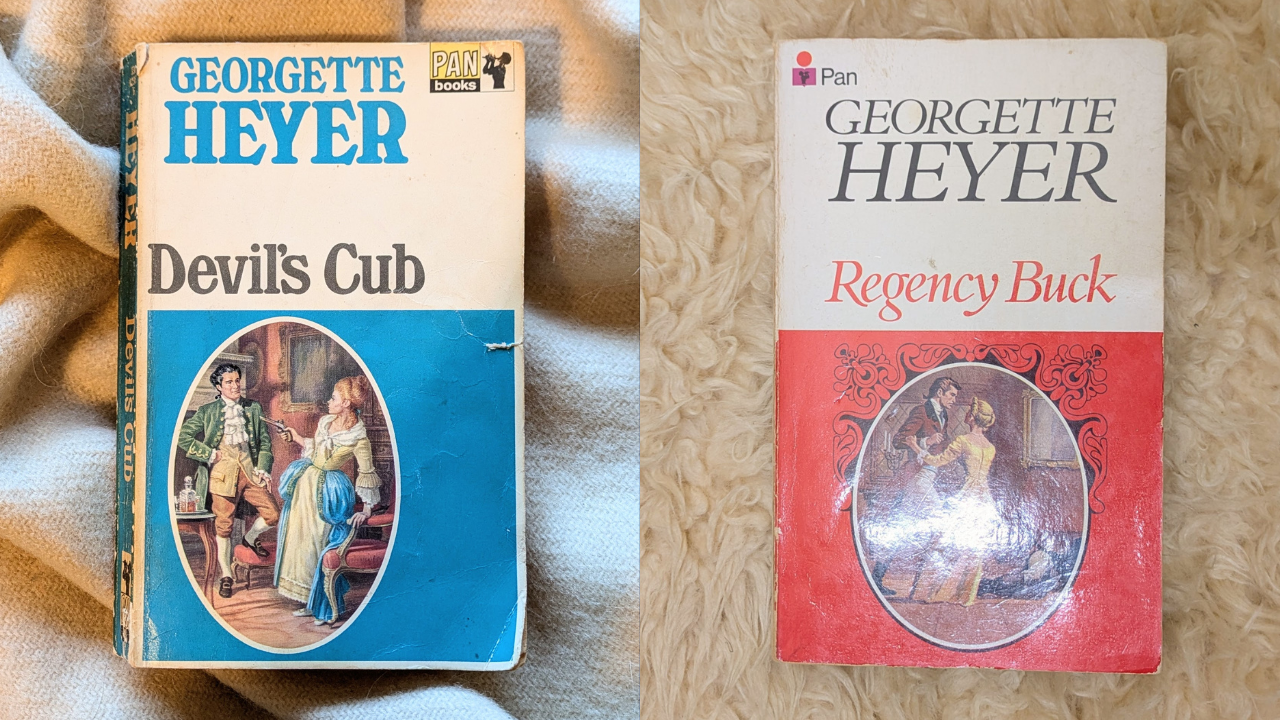
My project for 2026 of reading my way through Georgette Heyer's historical fiction has got off to a good start. The books of hers that I read in January were Devil's Cub and Regency Buck, as I indulged my interest in a particular character (Devil/Satanas from The Black Moth/These Old Shades) rather than forcing myself to read in strict publishing order. I wanted to follow him and his family through their next books and didn't worry much that I had skipped the rest of the 1920s. I will go back and read the books that I've skipped, when I feel like it. I'm trying to be completist but not rigid about this.
I liked Devil's Cub a lot — my review of that book is available to read here — and Regency Buck not as much. So far I'm finding that reading even a mid Heyer title is an enjoyable way to pass the time. I've really enjoyed chatting with other Heyer readers in the comments and in my inbox. The welcome I've had from long-time fans for these books has really validated my decision to immerse myself in them properly. You can find all my Heyer posts here, and the one about Regency Buck is here. If you'd like to receive those as email newsletters, adjust your settings here to do so.
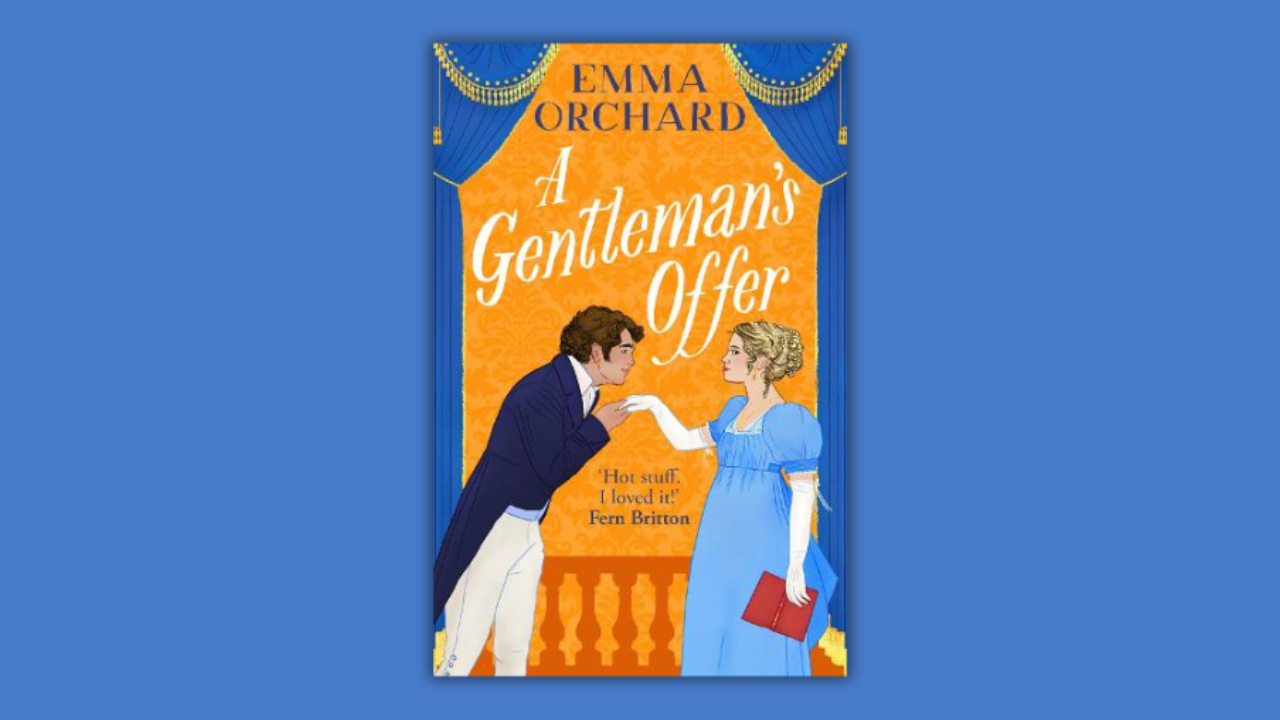
A Gentleman's Offer by Emma Orchard is a Regency romance novel published in 2025 that nonetheless is very connected to the work of Georgette Heyer. The author identifies herself as a Heyer fan and talks about how she got started publishing Heyer fanfiction during the first Covid lockdowns before moving on to her own original fiction. I'm coming to realise that all Regency romance exists in the shadow of Georgette Heyer, so it was nice to see that acknowledged and celebrated rather than left unspoken.
The plot of this book is more ridiculous and improbable than anything I've encountered in a Heyer novel so far: one half of a pair of twins absconds after her engagement to a famously eligible bachelor, her sister stands in for her, hijinks ensue. Of course, the other sister and the bachelor form a real attachment while they are keeping up the deception. Neither the characters nor the writing was especially memorable, although I had a nice time while I was reading it and would read more by this author in future.
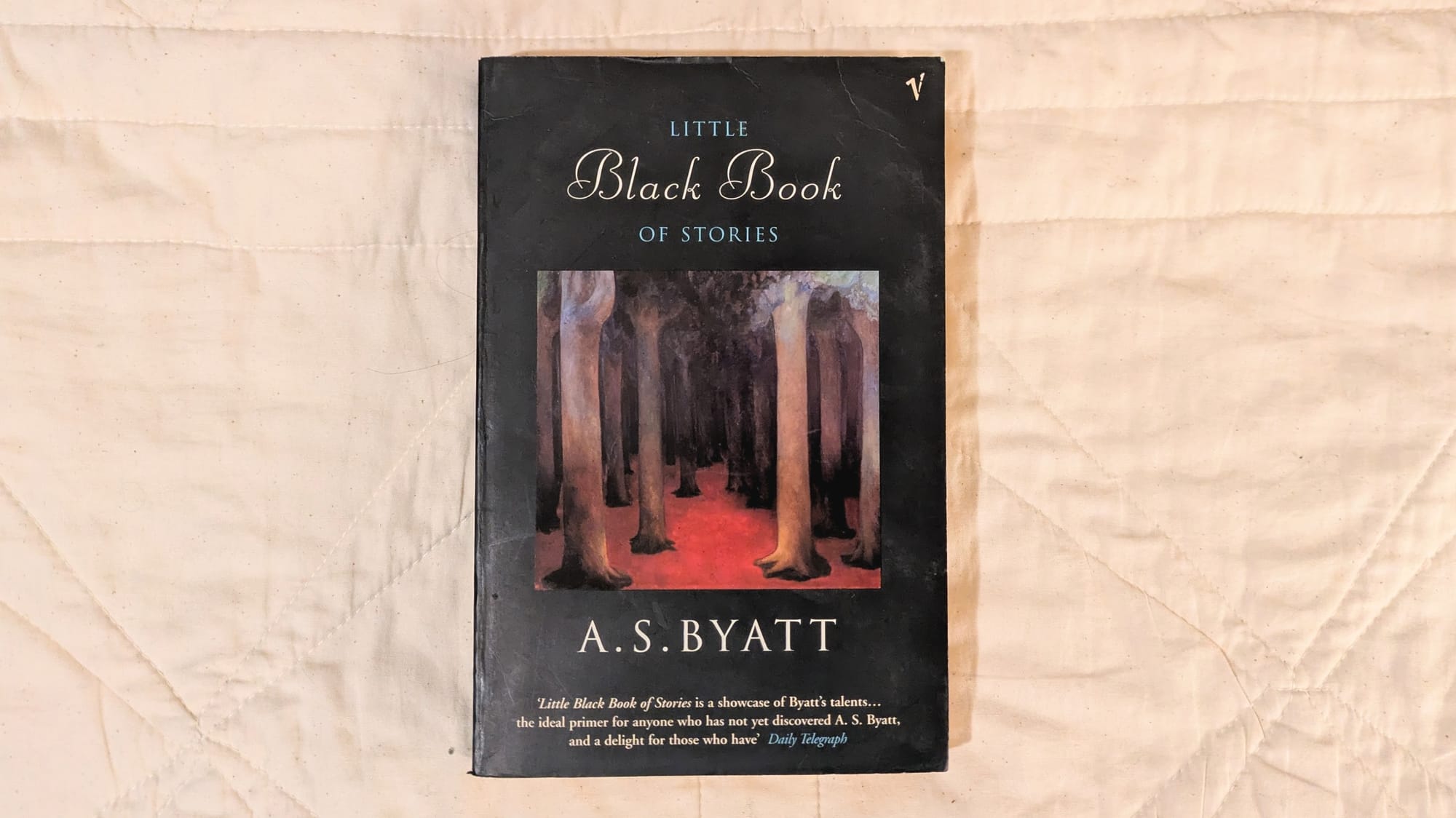
The Little Black Book of Stories by A.S. Byatt is one of the two books that I picked up again this month after a long pause. I started reading it on 22nd December 2024 and then put it aside because this dark-tinged, abstract collection of longer short stories was going to require more attention and literary appreciation than I had available at the time. I restarted it this month after making my plan to read only short stories at bed time to stop myself staying up too late reading "just one more chapter" of a novel. This perhaps wasn't the best book to start that habit with, because these are 50-75 page short stories and I sometimes took several evenings to finish one. They aren't very plot-driven, though, which allowed me to stay on track.
The five stories in this book all deal with the interaction of the mundane and the fantastical. "The Thing in the Woods" is about two women who, while WW2 evacuees at a country house, saw a little girl get eaten by said "thing", and then meet each other again in late middle age when they both return to the scene of the trauma to get some answers. "Body Art" is written from the point of view of a lapsed Catholic obstetrician who thinks he has left his hangups about abortion behind him with his faith, until the question becomes personal and he realises he isn't as liberal as he thought. I felt quite frustrated while reading this one and thought I didn't like it. In thinking about it since, though, I've decided it's a mark of the story's quality that it got me so riled up. "A Stone Woman" was my favourite in the collection. It follows a lexicographer as she begins to turn to stone — all kinds of stone, it's a beautiful, fascinating process — and goes on a trip to Iceland to explore the mythology there. "Raw Material" absolutely nails the awkwardness of trying to teach creative writing but I didn't feel like it really earned its ending. And "Pink Ribbon", a story about a man caring for his wife with dementia while having night-time encounters with a younger healthy version of her, was my least favourite, as I feel like it's an idea I've read more fully-realised examples of elsewhere. Altogether, this book provided me with a thought-provoking and satisfying introduction back into reading literary fiction. I did, however, agree with this reviewer who said that Byatt was a little too fond of including long lists in her stories.
The other book I restarted after a long pause was the audiobook of Brigands & Breadknives by Travis Baldree. I've enjoyed the two other instalments in Baldree's cosy fantasy adventure series, slightly prefering Bookshops & Bonedust to the more famous Legends & Lattes. I started this third book back in November and then gave up, not because it was bad, but because I was struggling to focus because of overwork and health issues.
When I started again from the beginning this month, I was delighted to find that Baldree's strengths as a narrator (recording audiobooks is his day job) were just as great as I remembered. At one point in this story he manages to voice quick-paced dialogue between about five different characters at the same time, two of which are talking swords. It's very impressive, the more so because I didn't even notice the complication of the scene until the situation recurred quite far on in the book. I was also impressed that he eschewed the template he had followed in Legends & Lattes — character starts a business, the story follows them as it progresses — for something more complicated. A character does renovate and open a shop at the start of Brigands & Breadknives... only to realise in the first few chapters that she hates running said shop. She runs away from her life and does something else instead.
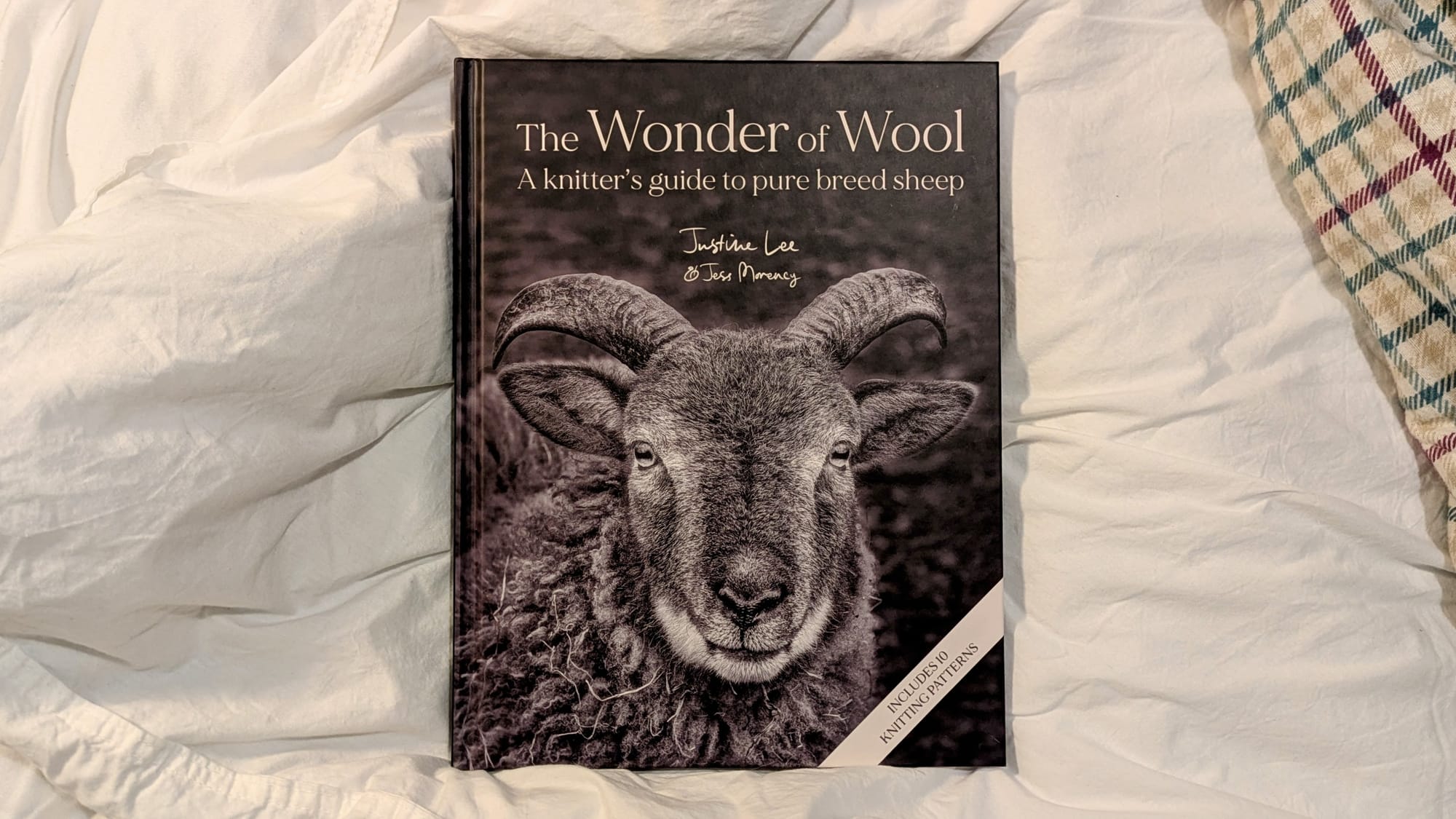
I began the year with The Wonder of Wool by Justine Lee and Jess Morency, which was a Christmas gift from my husband. This book is partly a history of the British wool industry and a guide to historic breeds, and partly a selection of knitting patterns designed to showcase the qualities of rarer wools. I read it in a day, some of which passed in a beautiful daydream about all the beautiful garments I would make if I didn't also have, you know, a job. A great gift for the knitter in your life who has strong opinions about natural fibres.
In my teens, I spent a lot of time playing an interactive fiction game called Hamlet: The Text Adventure. I enjoyed the snarky little additions the creator, Robin Johnson, made to the Shakespearean story (there's a room where you come across a character from another play, Othello, muttering about a "brazen tart") and the option to try and give Hamlet a happier ending. But what I liked most was having to hold a plan of Elsinore in my head to make any headway with the game.
At every juncture, the game spits out lines of text describing the surroundings and telling you which ways you can make your character, Hamlet, move. He can go north, south, east, west, up or down. Every movement is a choice, and the need to choose is constant. If you don't want to spend all your time in an endless loop or bouncing back and forth along the same corridor, you need to remember which doors go where and how to get back up to the balcony to chat with your father's ghost. Later, I got into management and building sims like RollerCoaster Tycoon, Caesar III and Pharaoh, where a continual awareness of the game map is also key to success. In those, however, you have the advantage of being able to scroll around and see your whole domain on the screen. Mastering Hamlet via text alone flexed an otherwise dormant muscle in my imagination. It was a nice feeling.
That Hamlet game was released in 2003. I hadn't thought about it for over twenty years. Then, in 2025, I started writing a novel — something I had never done in earnest before. It was an idea that I had been toying with for a couple of years, so the plot and characters were fairly fleshed out by the time I started typing. Dialogue, too, flowed quite easily. I could make my characters stand still and talk to each other for pages and pages. But even though the physicality of the world they inhabited was clear to me, every time I tried to make them move around in it, everything became very stiff and awkward. I found myself spending hundreds of words needlessly describing what it felt like to descend stairs or run down a garden path, just so that I could move them from A to B. Writing a plausible exit from a room was an ordeal. Eventually, I realised. I was back in front of that blinking cursor, trying to remember with no visual reference whether Hamlet needed to walk north or turn east to have his crucial encounter with Ophelia.
I started drawing maps. Of rooms, of houses, of whole neighbourhoods that exist only in my head. Anywhere that I needed a character to pass through, I scribbled a wonky diagram of it. That way, the decision about whether they would go north, south, east or west had already been decided before I started typing my sentences. All I had to do was describe their passage. I am very bad at drawing and none of these maps will ever see the light of day. Everything is out of proportion. I doodle all over them, trying to get a character's trajectory correct.
It has helped, though. My illegible squiggles curb my tendency to write like Arnold Bennet in the Virginia Woolf essay "Mr Bennett and Mrs Brown". He, she contends, will describe any amount of geography and other minutiae — whether the suburban villa is freehold or exactly what role the flour mill plays in the local economy — all the while completely missing the fascinating character of Mrs Brown, the actual inhabitant of this place. My version of this was the long discourse I wrote about the depth of pile on a staircase someone was descending. There was even a historical digression about the merits or otherwise of Axminster carpets. That is not still in the book.
I was reading for my job at The Browser recently and came across an image of a map drawn by Vladimir Nabokov that he drew as a teaching aid for a class he was giving on Ulysses. He superimposed the events of the book and the different characters' passage through them on a map of Dublin, so that you can track Leopold or Stephen through the city and through time. Further investigation revealed that he did this for several books, including Jane Austen's Mansfield Park. I began to feel better. His plan of the house and what its inhabitants are doing in chapter thirteen looks rather like one of my own drawings.
Drawing diagrams of the physical spaces I'm trying to people, rather than writing like I'm spinning a text-based adventure game out of thin air, has kept the novel inching forwards. The process of describing movement still feels laboured to me, even if the sentences I settle on in the end are not especially ponderous. E.M. Forster said in Aspects of the Novel that in fiction people "come into the world more like parcels than human beings". Sometimes I still feel like the postmistress, hefting sacks of heavy mail and managing the flow of post around my book.
Connections rarely announce themselves in the present tense. Parallels and associations are revealed with hindsight. I spent much of last year dealing with a health problem that limited my ability to move about. It's not a recurrence of the cancer I wrote about in A Body Made of Glass — I'm still cancer-free. I'm keeping the details private, but the fatigue and pain does remind me of chemotherapy. That feeling of being strapped into an invisible exoskeleton that I have to move about the world in addition to my own body.
When you feel like this, the way you move through the world changes. People with disabilities and chronic illnesses, who use spoon theory to manage their energy, have always known this. Where once I was Hamlet, dashing back and forth across the castle with abandon because the person playing him (me!) kept forgetting to pick up important objects, I once more needed to be aware of how many times a day I could feasibly climb the stairs. It changes what your environment looks like, too. Little piles mount up everywhere, because it's not worth going to the kitchen until I have a full armful of things to take.
Towards the end of 2025 I was able to start some treatment that somewhat improves my energy levels, albeit with side effects, while I wait for my turn at the top of the surgery waiting list. I'm lucky even to have a potential resolution on the horizon. It was only once I was no longer planning my trips around the house with quite so much care that I realised that I had been stuck like one of my own characters, unable to leave a room or climb the stairs without pages of thought and planning. They moved as I moved: slowly and with care.
I'm writing more quickly now, in part because I'm not so tired. I'm walking again and have permission to try running some very slow intervals soon if I feel up to it. I'm not as static as I was three months ago. And so I'm trying to give the same shift to my characters. To leave the diagrams behind and just move. Instead of looking at the door and thinking about whether to open it, we simply slam it behind us as we leave the room.
There have been many Heated Rivalry takes. This one — The Truth About Yearning – is the best one I have read. I haven't watched the show yet, because I'm saving it up for the next time I have to take to my bed with a lurgy, but I have enjoyed surveying the discourse.
This was an interesting, if somewhat singular, discussion of "how to make a lot of money as an author even if you're not an NYT bestseller". I applaud anyone who shares finances transparently like this, and I thought the writer did a good job of acknowledging the combination of luck and effort that this involves.
A debunking of some major literary conspiracy theories, including the one about how Francis Bacon wrote the plays of Shakespeare and — new one to me — that the KGB secretly assassinated Albert Camus.
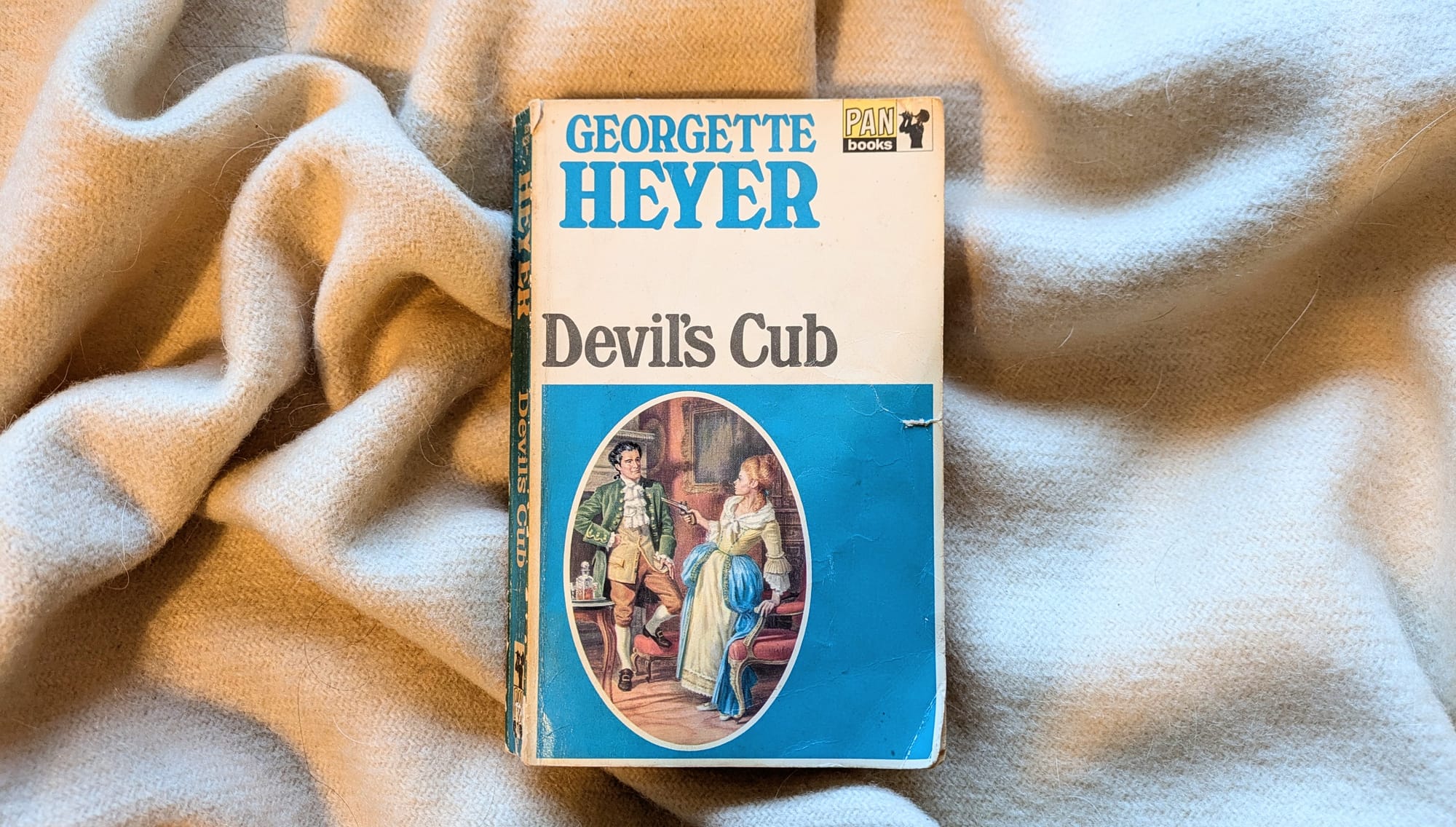
This is the 1969 Pan paperback edition of Devil's Cub. The novel was originally published by Heinemann in 1932.
My plan to read my way through Georgette Heyer's historical fiction in chronological order fell apart rather quickly. After my first two titles, The Black Moth and These Old Shades, I was so keen to keep reading about the character of "Devil" that I just skipped to his next book, 1932's Devil's Cub. Simon the Coldheart fans, I promise I will go back and read everything I've missed... Just as soon as I've satiated my desire for the Alastair family's adventures.
Devil's Cub picks up approximately 25 years after the end of These Old Shades. It follows the romantic entanglements of Dominic, Marquis of Vidal, son of Justin and Léonie who meet and fall in love in the previous book. Dominic is a rake with a capital R, and not in the toothless way that some contemporary historical romance writers like to gesture at. His behaviour is vicious and borderline criminal, as Heyer shows us in the arresting opening sequence. Dominic is travelling to a party and casually shoots a highwayman dead on the way, leaving the corpse still bleeding in the road. (I don't know if this is a sly wink at his father's sort-of outlaw origins in The Black Moth, but if it was I liked it.) I also appreciated Dominic's banter with his friend Charles Fox, who I think might be the first real-life historical figure with a speaking part that I have encountered in my reading of Heyer so far. Fox and the other high society types make it clear that they are less shocked by Dominic's habit of extra-judicial murder than they are by the fact that he doesn't bother to clean up the scene afterwards.
This becomes a recurring motif as we follow Dominic through the next few chapters. The denizens of the highest social circles of the early 1780s are not shocked by the same things that we would be today. Thus, Dominic's dalliance with Sophia, a "Cit", aka a bourgeois, middle-class girl, is far less acceptable than the time he spends with more professional paramours. "Opera dancers!", his Aunt Fanny mutters darkly at one point. The same goes for his duelling habit. He has killed at least one person in a duel before, in addition to his drive-by execution in the opening chapter, but it is only when he shoots someone indoors, in an impromptu duel in a gaming hell, that it is felt that he has crossed a line. By teasing out the subtleties of this flexible Georgian moral code, Heyer is able to gesture at the absurdity of Dominic's class without ever mocking or deriding her characters.
This was just one of many wonderful pieces of craft from Heyer that I admired while reading this book. I did feel like I had skipped quite a few phases of her development, because this writer from 1932 has many more tricks up her sleeve than the one who was writing in the early years of the 1920s. The pacing and plotting of this book is magnificent. Every time I thought to myself "I wish Dominic had a straight man to bounce jokes off" or "when is a parent going to show up and meddle in this", my wish was fulfilled on the very next page. Each character has a development arc, too. Dominic goes from dissipated rake to intense, protective fiancé, while Mary, his intended, learns to enjoy herself a little while still keeping her ethics intact. And the menacing appearance of Devil at the end, almost like a fairy godmother, to wrap the whole story up in a bow? Chef's kiss, no notes.
Mary Challoner is a much more complex and well-rounded character than any of the Heyer heroines I have encountered so far. She's the older sister of the lovely Sophia, who we learn is a "yallow-headed chit" with a "frippery brain". Sophia has indeed been blessed with gorgeous golden curls, limpid blue eyes and the ability to flirt like it's her job, whereas Mary is something bordering on a bluestocking. She's had a proper education and finds her mother's insistence on trying to convert Sophia's beauty into a place in the ranks of the nobility quite ridiculous. Mary is sensible and pragmatic, never letting her emotions get the better of her. No hysterics or vapours for her. My kind of girl.
The introduction of the Challoners allows Heyer to explore more class nuances than if the story was set solely among the haute ton. Mary's father was of noble birth and cut off by his family when he married her mother, who is merely the sister of a city merchant. The widowed Mrs Challoner takes her inspiration from Mrs Gunning, the real-life mother of two beauties who in the 1750s sent ripples through society when they managed to marry a Duke and an Earl respectively. What Mrs Challoner seems to have missed, though, is that even though the Gunning sisters were not at all wealthy, they were of aristocratic origin — both their parents were of the Irish nobility, with their mother being the daughter of a viscount. Sophia might be beautiful, but with her vulgar manners and nothing but a "bundle of Cits" in her family tree, she stands no chance.
The incident that pushes Mary out of her comfortable milieu and onto the path to wedded bliss is a typically cunning piece of work by Heyer. A note arrives addressed to "Miss Challoner", which is delivered to her as the eldest daughter of the house. It's from Dominic and was meant for Sophia, since it gives all the details of their planned flight from London together — he thinks they're going to have a lovely roll in the hay while he lives down the shame of his latest duel, while Sophia thinks she can trick him to the altar somehow and become a Marquess. Not only does the note allow Mary to pre-empt the scheme, taking Sophia's place to protect her sister's reputation and marital prospects, it also shows how little regard for Mary Dominic has early on in the book. He has forgotten that she exists at all, hence the application of her rightful title to her younger sister. This gives their early scenes together on the road greater tension and makes the eventual resolution feel completely earned.
What Devil's Cub has that my previous Heyer reads lacked is a very capable handling of shadow and light. Every sweet, happy moment has a drop of darkness to it, and every melodramatic scene is undercut with humour. From Dominic's first entrance as a cold-blooded lout to Mary's very serious conversation with Devil at the end, there is always something that makes the reader smile. By the time she published Devil's Cub, Heyer was the author of (I think?) eleven other novels. She had clearly learned from the writing of every one of them, because this one is a triumph.
Five Other Thoughts
The secondary couple, Dominic's cousin Juliana and her self-effacing beau Frederick, were my least favourite thing about this book. The latter amply demonstrates that there's nothing so annoying as someone who says "no, whatever you want" when you're trying to make a plan. It's a performance of courtesy and humility that actually throws the onus on the other person to do all the thinking and decision making. No wonder Mary comes to find him infuriating. An attractive romantic lead is also one who can think for themself! I have to imagine that Juliana will force him to be a little more decisive in future.
I enjoyed the scene where Dominic involuntarily snaps the sticks of Juliana's fan, so upset is he at the very idea that a lady of his, ie Mary, would ever flirt with another man. It's very like his father's habit of crushing snuffboxes when angry.
I'm getting the sense that Heyer really didn't like the colour puce. Only terrible bores — like Mary's cousin and unwelcome suitor Joshua — wear puce. And someone always comments on how much it doesn't suit them.
I adored Uncle Rupert's love affair with his six dozen bottles of port. I hope they all got home safely.
I felt slightly offended on behalf of the town of Dijon. I'm sure it is a nice place! The other characters were offensively astonished that someone as rich and fashionable Dominic would ever go there.
My Favourite Phrases
Juliana is a "rattle-pate".
Two good financial words — "dunning" and "milleleva" (I think the latter is a bit like a "pony" ie an amount of money one might lose while gambling).
Mary is at one point described as "Miss Prunes and Prisms".
A "sulky", a type of carriage.
Dominic says to Mary that her conduct in running away with him was that of "the veriest trollop".
Thanks for reading. I'm making making way through Georgette Heyer's historical novels — you can find all the entries so far here.